Deserts That Didn’t Used to Be Deserts
Explore fascinating regions that transformed from lush landscapes to arid deserts over time.
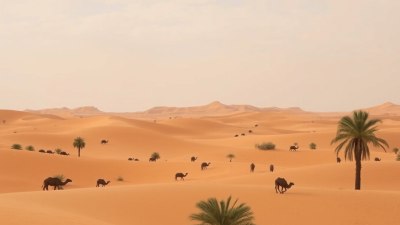
Image created with Flux Schnell
Deserts, often depicted as barren wastelands, actually have diverse histories that tell tales of changing climates and environments. Understanding deserts that didn’t used to be deserts reveals much about our planet’s dynamic climate system. This article explores several significant regions, their past lush landscapes, and the transformations that led to their current status as arid environments.
The Sahara Desert
The Sahara Desert is the largest hot desert in the world, but it wasn’t always the sandy expanse we see today. Thousands of years ago, this region was a thriving green ecosystem teeming with life. Evidence suggests that around 10,000 years ago, the Sahara was a lush paradise, dotted with lakes and rivers, supported by a humid climate. Early human settlements prospered in this verdant landscape, with archaeological findings illustrating the existence of early agriculture and intricate cave paintings depicting animals that roamed freely. The transformation of the Sahara into a desert can be attributed to natural climate oscillations, primarily driven by the Earth’s axial tilt and shifts in rainfall patterns during the Holocene epoch, leading to the now arid desert we recognize.
The Arabian Peninsula
Alongside the Sahara, the Arabian Peninsula hides a rich history beneath its sandy surface. Once, it was not the arid land we perceive today but rather a fertile region abundant with vegetation and water bodies. Roughly 10,000 years ago, this area experienced a much milder climate, allowing for a lively biodiversity. Ancient rivers and lakes flourished here, offering sustenance to early human tribes. The gradual decline into a desert landscape is attributed to climate change and the Taklamakan Desert's complex interactions with monsoon patterns, coupled with increased aridity. Today, remnants of its lush past can still be found in geological formations and ancient artifacts.
The Great Basin Desert
Nestled in the United States, the Great Basin Desert was once a vast and fertile lake system known as Lake Manly. This expansive water body flourished during the last Ice Age, providing a significantly different environment than today’s desert. As the climate warmed, Lake Manly gradually shrank due to evaporation and the redistribution of water to neighboring basins. Over time, this led to the emergence of the current Great Basin Desert. Geologists have studied sediment records that reveal this transformation, indicating dramatic shifts in ecosystems and climate. Today, although predominantly arid, it's still home to various flora and fauna adapting to its challenging conditions.
The Atacama Desert
The Atacama Desert in Chile is considered one of the driest places on Earth. However, geologic studies indicate that parts of the Atacama were once covered by water. Fossilized remains of aquatic creatures and evidence of ancient riverbeds reveal its past as a vibrant marine ecosystem. Previously under the influence of moist weather patterns, the area eventually transformed under the effects of tectonic uplift of the Andes and rain shadow effects, leading to the extreme aridity we experience today. Despite being incredibly inhospitable, this desert plays an important role in scientific research and biodiversity.
The Kalahari Desert
The Kalahari Desert, located in southern Africa, was once a verdant savanna ecosystem home to diverse wildlife. Within the past several thousand years, shifts in the climate have transformed it into a semi-arid environment, although it still hosts a unique array of flora and fauna. Research in sediment cores reveals that periods of increased rainfall were common, allowing significant vegetation to thrive. As the climate changed, the Kalahari’s lush landscapes diminished, leaving behind a stunning, arid expanse characterized by vast sand dunes and dry riverbeds. The Kalahari Desert showcases resilience and adaptability in a changing climate.
The Mojave Desert
The Mojave Desert in California is famous for its striking landscapes and diverse ecosystems. However, historical records suggest that this region was once much wetter, hosting lush vegetation and wetlands. Ancient maps indicate that glacial meltwater from nearby mountains fed extensive river systems that once thrived in the area. Over time, climatic changes and geological uplift altered the moisture distribution in the region, leading to the desert we recognize today. While the current aridity presents challenges for life, the Mojave remains a hotspot for unique biodiversity and adapted species.
The Namib Desert
The Namib Desert in Namibia is another example of a region that wasn’t always barren. Fossil evidence suggests that much of this area was previously covered by forests and grasslands teeming with wildlife. As global climate patterns shifted and rainfall decreased, it evolved into the arid desert we see now, characterized by vast sand dunes and rocky plains. The evolution of the Namib reflects the long-term climate changes affecting different parts of the planet, demonstrating the delicate balance between ecosystems and climatic conditions.
Lessons from the Past
The study of deserts that once flourished highlights critical lessons about climatic resilience and adaptability. As we face contemporary issues related to climate change, deforestation, and habitat loss, investigating these shifts can provide essential insights into how ecosystems respond to environmental pressures. Furthermore, understanding the dynamics of past climates can offer valuable perspectives on future climate scenarios and their potential impacts on global biodiversity.
In conclusion, the deserts of today encompass stories rich in ecological history and transformation. Each region discussed has traversed a path from verdant landscapes to arid environments, showcasing the ever-changing nature of our planet’s climate. As we confront environmental challenges today, the exploration of these deserts encourages us to appreciate the complexity of ecosystems and the importance of sustainable practices to protect our fragile Earth.