The Sound of Light in the Northern Skies of Norway
Explore the mesmerizing sounds of the Northern Lights in Norway's magical skies.
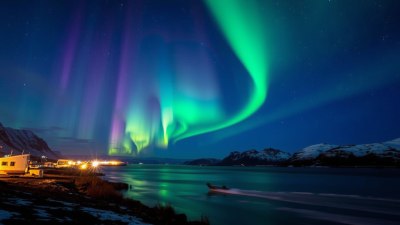
Image created with Flux Schnell
The enchanting realm of northern Norway is not just a visual wonderland, but also a symphonic experience waiting to be unveiled. Known for its breathtaking scenery, Arctic wilderness, and the spectacular auroras, Norway offers a unique intersection of light and sound that captivates both locals and tourists alike. The Northern Lights, or Aurora Borealis, dance across the night sky in brilliant greens, pinks, and purples, creating a spectacle that has been romanticized in folklore and scientific study for centuries. But intriguingly, there's more to the Auroras than just a visual feast. Could there be a sound accompanying this stunning light show? Join me on a journey to uncover the sonic phenomenon intertwined with the stunning visuals of the Northern Lights.
The phenomenon of the Northern Lights is caused by solar winds colliding with the Earth's magnetic field, resulting in stunning displays of color. These collisions occur at altitudes between 80 and 300 kilometers in the upper atmosphere, where charged particles interact with gases, leading to the stunning light displays. This captivating spectacle is often witnessed in regions close to the Arctic Circle. Scientifically, the beauty of Auroras is explained through complex electromagnetic interactions, but the sensory experiences associated with them go beyond vision alone. On numerous occasions, observers have reported hearing sounds during these nocturnal displays. What could be the source of these so-called 'sounds of light'?
Auditory Experiences Reported
Throughout various cultures and regions, people have documented auditory phenomena accompanying the Auroras. Observers have described sounds like hissing, crackling, or even faint musical notes. Some witnesses have likened the sounds to rustling leaves or the crackling of a fire. Although these experiences have been largely anecdotal, recent studies and experiments suggest that conditions might allow for real auditory effects under certain circumstances. Factors like atmospheric electricity and the Earth's magnetic fields on a chilly, clear night might generate sounds. Contemporary scientists have sought to validate these accounts and have initiated methods to study these auditory phenomena associated with Auroras.
Scientific Perspectives
Scientific investigations have dwelled into the relationship between the Northern Lights and any auditory feedback. This exploration often involves acoustic studies to examine whether any genuine sound waves are produced during Aurora displays. A particular phenomenon called static electricity—due to the buildup and movement of charged particles—may lead to low-frequency sounds detectable to the human ear under perfect conditions. Researchers have been working to capture and document these sounds in various settings across Scandinavia. Some recordings led scientists to affirm that, in specific conditions, Auroras may produce sounds which could only be perceived at low altitudes, rendering them inaudible to most observers who view them from higher altitudes.
The Role of Environment
The surroundings play a crucial role in experiencing the sounds tied to the Northern Lights. Areas with minimal light pollution and preserved natural landscapes enhance the probability of auditory encounters. Factors including humidity, temperature, and wind can affect the sound's propagation. For instance, certain conditions might create an environment where sound waves can travel better or sharpen certain auditory qualities. Most reports arise in isolated areas, far from urban disturbances, where the background noise from civilization dissipates, allowing natural sounds to emerge more distinctly. Norway's scenic vistas often provide such perfect conditions.
Culture and Folklore
Across cultures, the Northern Lights have inspired countless legends and myths. The Sámi people, indigenous to the areas of Norway, have long held a profound connection to the Northern Lights and attributed various meanings to this celestial phenomenon. They believed the aurora borealis to be the spirits of their ancestors dancing in the sky, and some stories elaborate on the connectivity between the sounds of these spirits and the lights themselves. Such narratives highlight the historical context of the auditory experiences associated with the Auroras, emphasizing how deeply it resonates with their folklore. The encapsulation of auditory elements in tales about the Northern Lights nourishes the ongoing dialogue surrounding their impact beyond vision.
Photography and Sound Art
As interest grows in the Northern Lights, so does the intersection of photography and sound art. Artists and sound designers are now exploring synesthetic experiences, combining visual elements with soundscapes reflecting Northern Light phenomena. Capturing the essence of the Auroras through photography while exploring the potential auditory experiences creates an immersive aspect for spectators. Certain artists are attempting to recreate sounds believed to accompany the Auroras, providing audiences with a complete sensory experience. Public installations, exhibitions, and showcases are now emerging wherein visitors can experience the synergy of light and sound associated with the Northern Lights.
The Science of Sonic Light
Delving into the scientific inquiries provides a deeper understanding of the connection between auroras and sounds. Researchers have proposed that any sounds associated with the Northern Lights likely arise due to atmospheric phenomena and lower altitudes of charged particle motion. Initiatives are underway to utilize sound recorders during northern light events to understand precisely how sounds correlate with auroras. The idea is to explore how various auditory experiences evolve alongside visual displays, investigating dynamic interactions between auroras and Earth's atmosphere.
Experiencing the Sounds of Light in Norway
Visiting Norway to observe the Northern Lights can become a memorable experience, especially when enhanced by sounds. Seek the northern coasts during peak aurora seasons—late autumn through early spring—specifically around geometrical alignments in terms of longitude. Popular locations like Tromsø and the Lofoten Islands serve as prime destinations. By venturing into the natural landscapes, enjoying the silence of the Arctic night, and listening carefully, you may encounter the elusive sounds accompanying the visual spectacle. Remember, having a reverent space to feel the Auroras, both through sight and sound, ensures a profound experience.
A Sonic Voyage
The journey of uncovering the intricate connection between sound and light in Norway's northern skies invites us to explore beyond the visual splendor of the Aurora Borealis. The cultural narratives, scientific inquiries, and artistic explorations foster a rich tapestry that enchants adventurers seeking unmatched experiences. The symphony of the Northern Lights is a reminder of how nature provides ears with stories woven into the breathtaking landscapes that surrounds them. So, when you find yourself amid the dancing lights of Norway, listen closely; you might just hear the sounds of a celestial ballet unfolding in the skies.