Chichen Itza in Mexico Counts Time Differently Now
Explore how Chichen Itza's unique calendar system influences our understanding of time.
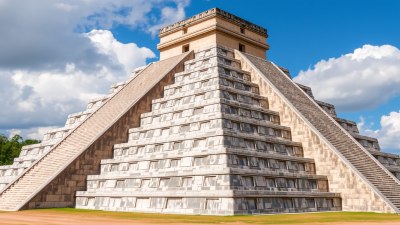
Chichen Itza, one of the most iconic archaeological sites in Mexico and a UNESCO World Heritage Site, is renowned for its ancient Mayan architecture and rich cultural history. Its famous pyramid, El Castillo, isn’t just a breathtaking spectacle; it's a sophisticated astronomical observatory. The ancient Maya were exceptional astronomers and mathematicians, who understood the cyclical nature of time in a way that differs greatly from contemporary interpretations. In modern times, Chichen Itza counts time differently, reflecting not just the ancient traditions but also contemporary understandings of timekeeping and cultural heritage.
The central piece of Chichen Itza’s timekeeping is the Pyramid of Kukulcán, also known as El Castillo. Each side of this pyramid has 91 steps, adding up to 364. When the top platform is included, the total equals 365, representing the days of the solar year. This structure demonstrates the Mayan civilization's intricate understanding of solar cycles and their importance in agricultural practices, rituals, and daily life. As it stands, the pyramid is much more than a mere architectural feat; it is a monumental symbol of the Mayan's connection to time and the celestial world.
The ancient Maya distinguished not only between day and night but also incorporated the cycles of the planet Venus into their timekeeping systems. Divided into various calendar systems, the most notable among them are the Tzolk’in (a 260-day ceremonial calendar) and the Haab’ (a 365-day solar calendar). The Tzolk’in is comprised of 20 periods of 13 days, while the Haab’ consists of 18 months of 20 days each, plus an additional month of five ‘empty’ days. This unique duality represented a holistic approach to interpreting time, fundamentally different from the linear progression of hours, days, and years in our contemporary lives.
Interestingly, Chichen Itza's cosmological perspective on time was cyclical. The Maya did not see time as a straight line but rather as a series of cycles that repeated indefinitely. This ancient philosophy imbues their traditions and is especially noticeable during significant astronomical events, such as the equinoxes. Each year, thousands of visitors flock to the site during the Spring and Autumn equinoxes to witness a mesmerizing illusion created by sunlight and the pyramid’s design—where shadows create the appearance of a serpent slithering down the staircase. This event harkens back to their beliefs in agriculture and the cycles of nature, creating a curriculum of harmony and balance.
In understanding how Chichen Itza counts time differently today, one must also acknowledge the role modern technology and research play in reinterpreting Mayan calendars. With contemporary software and astronomical tools, researchers have gained deeper insight into the Mayan calendar systems, revealing their remarkable accuracy. The ancient Maya could predict solar eclipses and other celestial events with exceptional precision, often aligning their temporal practices with what we now know in our astronomical studies. This merging of ancient and modern calendrical systems reflects a growing appreciation for the knowledge that indigenous cultures have contributed to our understanding of time.
Moreover, the current understanding of time at Chichen Itza also has implications for tourism and cultural preservation. As visitors seek to experience the ancient site not simply as a destination but as a means of connecting with history and culture, this understanding encourages sustainable tourism practices. By promoting respect for the Mayan interpretation of time, stakeholders can help maintain the integrity of the site, emphasizing the importance of cultural heritage amid the pressures of modernization.
Time is, and always has been, a central aspect of human life, shaping our rituals, agricultural cycles, religious practices, and daily activities. The ancient Maya’s perspective on time challenges the linear interpretation commonly accepted today. They recognized the significance of celestial events, leading to a calendar that was intrinsically aligned with the rhythms of the natural world. As a result, Chichen Itza serves as a living monument, a reminder of the wisdom of the ancestors and their profound understanding of time’s cyclical nature.
As archaeologists and historians continue to unravel the complexities of Mayan civilization, the richness of their knowledge about time becomes even more apparent. Not only did they innovate methods to track celestial events, but they also built intricate sites like Chichen Itza that embody these principles. Events such as the equinoxes are now celebrated not just as astronomical occurrences but as cultural festivals, reinforcing community ties and respect for heritage.
Every visit to Chichen Itza offers a chance to reflect on diverse experiences of time—past and present. Travelers from around the world come together to witness the interplay of culture and nature, to acknowledge the legacy of the Maya who once thrived in this area. As they stand before the majestic pyramid, there's a palpable connection to a time when humanity’s relationship with the universe wasn’t governed merely by clocks and calendars but instead was a dance with the cosmos itself.
The site also attracts scholars and enthusiasts from various fields—anthropologists, archaeologists, historians, and even astronomers—who find a newfound understanding of how different cultures perceive and measure time. This multidisciplinary approach brings further depth to how we interpret Mayan knowledge and their contributions to global civilization.
The modern narratives surrounding Chichen Itza not only help preserve the history of the ancient Maya but also encourage a more inclusive understanding of time. They invite us to reconsider our rigid frameworks of understanding and engage more closely with a worldview that offers flexibility and connection to the environment. In essence, Chichen Itza counts time not just differently but also more holistically, reflecting an intricate bond between people, nature, and the cosmos.
This perspective opens avenues for further discussions in our global society, serving as a reminder that time can be both personal and communal. Each era and culture offers unique insights that challenge us to embrace our diversity and grow from it. Therefore, approaching time at Chichen Itza is an opportunity to uplift the ancient narrative while integrating our current reality into a more comprehensive understanding of human experience.
Finally, as one walks away from the ancient site, it's essential to carry with us the teachings of Chichen Itza—that time is more than just numbers on a clock. It is the manifestation of life itself, the cycles of nature, and our interconnectedness within this vast universe. By embracing this broader perspective, we honor the ancient Maya while enriching our own understandings of time, allowing us to appreciate the fullness of existence.