The Terracotta Army in China Still Thinks the War Isn’t Over
Explore the enduring legacy of the Terracotta Army and its historical significance.
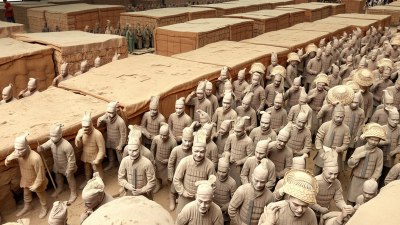
The Terracotta Army, a massive collection of clay soldiers, horses, and chariots, was buried with Qin Shi Huang, the first Emperor of China, to protect him in the afterlife. Discovered in 1974 by farmers in the Shaanxi province, this archaeological site offers a glimpse into ancient China's military might and funerary practices. For nearly 2,200 years, these figures have laid undisturbed beneath the earth, and their story continues to resonate profoundly in modern times. The notion that the Terracotta Army believes the war isn’t over suggests a continual struggle between interpretations of history and the legacy left behind by this significant site.
The Terracotta Army consists of over 8,000 life-sized figures, each uniquely crafted, representing an entire army that was meant to accompany the emperor in his afterlife. This monumental creation displays not only the artistic skills of the artisans of the time but also reflects the centralized power of the Qin dynasty and its military organization. The soldiers are arranged in battle formations, with chariots and cavalry units, showcasing the strategic prowess of the period.
The Historical Context of the Terracotta Army
To fully appreciate the significance of the Terracotta Army, one must understand the historical context in which it was created. The Qin dynasty, which lasted from 221 to 206 BC, was marked by significant achievements, including the unification of China, the standardization of currencies, measurements, and even script. Emperor Qin Shi Huang sought to leave a lasting legacy, and he believed that the afterlife was an extension of his life on earth, which led to the construction of this vast mausoleum.
This monumental burial site is part of a larger complex that includes the emperor's tomb, which has yet to be excavated. It is thought that this tomb, located near the city of Xi'an, is filled with vast treasures and booby traps to protect the emperor in the afterlife. Although the terracotta figures represent military strength, they also symbolize the emperor's desire for immortality and power.
The Discovery and Its Impact
The discovery of the Terracotta Army in 1974 was a watershed moment in archaeology. Farmers digging a well stumbled upon the first figures, sparking a series of excavations that uncovered thousands of artifacts, each revealing more about the artistry and culture of ancient China. International interest in the Terracotta Army skyrocketed, leading to exhibitions around the world that showcased this incredible site and its artistry.
Since its discovery, the Terracotta Army has been the subject of extensive research and debate. Scholars have examined the construction techniques, the purpose of the figures, their historical context, and how they fit within the larger narrative of Chinese history. The site has also become a crucial part of China's cultural identity, drawing millions of tourists each year who come to witness this ancient wonder.
The Terracotta Army Today
Today, the Terracotta Army is more than just a historical artifact; it symbolizes China's rich cultural heritage and the enduring legends of its past. The ongoing work at the site continues to reveal new findings, which challenge previous understandings and interpretations. This continuous excavation highlights the notion that perhaps the army figuratively believes that the war isn’t over, as new narratives are constantly being constructed around it.
In recent years, technological advancements in imaging and analysis have provided archaeologists with new tools to study the site. Ground-penetrating radar and other methods allow researchers to uncover hidden chambers and additional figures that may still lie buried. These discoveries pose questions about the extent of the burial complex and the mysteries that continue to linger around the life of Emperor Qin Shi Huang and the afterlife he envisioned.
Cultural Resonance and Legacy
The Terracotta Army holds a dual significance in both historical scholarship and popular culture. It stands as a testament to the skills and ingenuity of ancient Chinese artisans and reflects the political climate of the time. Additionally, it has infiltrated contemporary culture, inspiring countless references in literature, film, and art. The figures have become icons of Chinese heritage, representing not only the historic past but also the profound philosophical questions that arise about mortality and power.
Moreover, the Terracotta Army serves as a stark reminder of the consequences of war. While these figures are symbols of military might, they also evoke thoughts on the human costs of conflict. Each soldier represents an individual who served, fought, and ultimately became a part of a larger narrative that sought to define power and legacy through conquest. By reflecting on the history embodied in these figures, one may glean insights into contemporary conflicts around the world, emphasizing the ongoing relevance of these ancient symbols.
Tourism and Conservation Efforts
As one of the most significant archaeological sites in the world, the Terracotta Army attracts millions of visitors each year. The site has been developed into a significant tourism hub, complete with museums, educational centers, and facilities to support the influx of global visitors. However, this popularity also necessitates careful conservation efforts to preserve the delicate figures and the site itself.
Conservationists work tirelessly to protect the Terracotta Army from environmental threats, human interference, and natural decay. Their efforts underscore the belief that the stories held within these artifacts must be preserved for future generations. The ongoing conservation and excavation work remind us that the history encapsulated within the Terracotta Army is still being unearthed, and its lessons continue to be relevant today.
Myths and Modern Interpretations
The Terracotta Army is shrouded in myth and legend. Folk tales and theories abound regarding the origins of the army, the fate of the emperor, and the meaning of the figures themselves. Some believe that the soldiers were created to serve as protective spirits, while others speculate about the supernatural elements of the site. These myths add layers to the understanding of the Terracotta Army, illustrating how historical artifacts can transcend their origins and acquire new meanings over time.
In contemporary discourse, the Terracotta Army often appears as a symbol of state power and control. Discussions surrounding nationalism and identity frequently reference this extraordinary collection, linking it to broader themes of cultural heritage, memory, and collective identity. The debate about how the Terracotta Army should be presented, interpreted, and integrated into China's national narrative reveals the complexities of historical memory in a rapidly changing world.
The Future of the Terracotta Army
As the site continues to be studied and excavated, the future of the Terracotta Army holds promising possibilities and unanswered questions. What secrets remain hidden within the complex? How will the ongoing research shape our understanding of the Qin Dynasty and its legacies? Will new techniques for preservation and interpretation enable future generations to engage with these figures in innovative and meaningful ways?
The Terracotta Army embodies the intersection of history, art, and cultural identity. As time progresses, the dialogue surrounding these figures will inevitably evolve, but their presence serves as a constant reminder of the human capacity for creativity, ambition, and the instinct to leave a mark upon the world. The idea that the war isn’t over resonates deeply within these ancient formations, inviting both reflection on the past and engagement with the present and future.