The Victory Column in Germany Wonders What It’s Really Celebrating
Exploring the historical significance and symbolism of Germany's Victory Column.
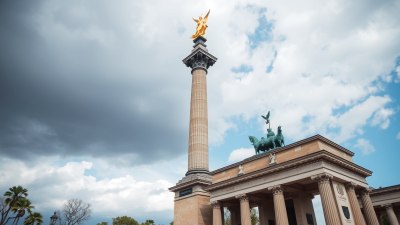
Image created with Flux Schnell
The Victory Column in Berlin, known as the Siegessäule, stands tall as a monumental ode to military victories yet prompts reflection on the true essence of celebration. Initially erected to commemorate Prussian victories in the Denmark, Austro-Prussian, and Franco-Prussian wars, the column has evolved into a symbol far more complex than its origins suggest. Its golden angel, the 'Goldelse', perpetually gazes down upon the city, embodying ideals of victory while simultaneously igniting discussions about nationalism, war, and the costs of glory.
This iconic structure, completed in 1873, was designed by the architect Heinrich Strack, standing at 67 meters tall with its impressive base and history-filled ascent. Originally placed in the center of the Platz der Republik, the Victory Column was later relocated to its current site at the Tiergarten, allowing it to be enveloped by the peaceful greenery of one of Berlin's most beloved parks. However, the transformation of its surrounding environment has not diluted the heavy historical context the column carries.
The Origins of the Victory Column
At the time of its construction, the column was intended to celebrate the unification of Germany, achieved through a series of decisive military engagements. The battles of 1864, 1866, and 1870-71 provided a backdrop of national pride that resonated deeply with the people of the time. The towering column, embellished with gold and intricate sculptures, symbolizes a turning point in German history where regional identities melded into a unified empire.
Yet, as history unfolded, the symbol of the Victory Column took on an unsettling duality—representing both the triumphs of a young state and the implications of militarism inherent in its construction. Those victories, while momentous, came at a crucial cost—loss of life, the devastation of war, and the moral ambiguities surrounding national pride. The question lingers: does a victory justify the means? As Germany has evolved, so too have our interpretations of symbols like the Victory Column, urging us to reassess and reflect on what we celebrate.
The War-Tainted Foundations
The narrative surrounding the Victory Column is not without its controversies. The celebrations of the unification brought forth a militarism that many historians suggest sowed seeds for future conflicts, notably World War I and World War II. The fervor of nationalism that intertwined with the victories celebrated by the column propagated an ideology that, at times, overshadowed the human cost of war.
In the context of its aesthetic grandeur and historical importance, the column also reminds us of the wars that shaped modern Europe. Many cities across the continent boast similar monuments; however, none quite encapsulate the dichotomy of nationalism and the harrowing price of such triumphs as effectively as the Victory Column. This tension remains palpable as visitors approach the monument, drawn to its allure while simultaneously being confronted with its complex legacy.
Symbol of Peace or Militarism?
Ironically, the location of the Victory Column today invites a broader conversation about peace. Set amidst the serenity of the Tiergarten, a park where families gather and friendships are forged, the column’s presence serves as a juxtaposition. Its glory may be celebrated, but it also serves as a poignant reminder of a time when military success and expansion characterized national pride.
The contrasts embodied by the site encourage visitors to ponder the implications of commemorating war. As Germany has transitioned into a champion of diplomacy and reconciliation, the column's existence breeds an essential dialogue about how societies choose to remember their past. Rather than serving solely as a celebratory beacon, perhaps it can stand as a testament to the resolve to avoid repeating the triumphalism that often precedes conflict.
The Evolving Narrative in Modern Germany
Today, the Victory Column plays various roles beyond merely standing as a relic of the past. It is a familiar backdrop for events that foster community and participation, acting as a historical frame to the progressive strides Germany has made in the domains of social justice, ecological responsibility, and international diplomacy. Current practices encourage a deeper understanding of the complexities associated with the symbol. Festivities include enlightening dialogues that grapple with historical memory, urging individuals to confront the darker aspects of national pride.
This evolving narrative reflects the ever-changing perception of the Victory Column. What started as a herald of military pride has morphed into a critical point for dialogue regarding peace, national identity, and collective memory. Visitors flock to see the structure, but they also engage in deeper reflections as they traverse the Tiergarten, embodying a reconciliation of past triumphs with contemporary ideals for peace.
Embracing the Complexity of History
To regard the Victory Column solely as a triumph of war is to disregard its full significance. It serves as both a celebration of victory and as a prompt for necessary reflection on the ideologies that shape our understanding of history. The architectural marvel transcends its role as a mere monument, embodying the complexities of national identity wrestling with memory and responsibility.
As we contemplate the legacy of the Victory Column, it emerges as a profound invitation for dialogue: a chance to scrutinize the narratives of history and choose how they shape our pathways forward. Interrogating what is celebrated within its shadow urges us to foster a mindful remembrance, guided by reflections on both glory and suffering. Embracing this complexity offers the possibility for a more inclusive understanding of victory, one that honors all facets of history.
A Symbol for Reflection
In a world eager for tangible symbols of strength and resilience, the Victory Column in Berlin emerges as more than a mere homage to military prowess. It stands as a testament to the intricate tapestry of German history, where the celebration of victory coexists with the burdens of memory. As the winds of change sweep across Europe, the ongoing discourse surrounding this monument emphasizes the need for dialogue about our past, reminding us that every victory carries stories untold.
The act of standing before the Victory Column thus transcends its physicality; it becomes an engagement with history that demands introspection. It is through these reflections that we can truly honor the legacies of the past while steering towards a promising path of peace and collaboration for future generations.